At a time when environmental problems and climate change are becoming increasingly important, the...
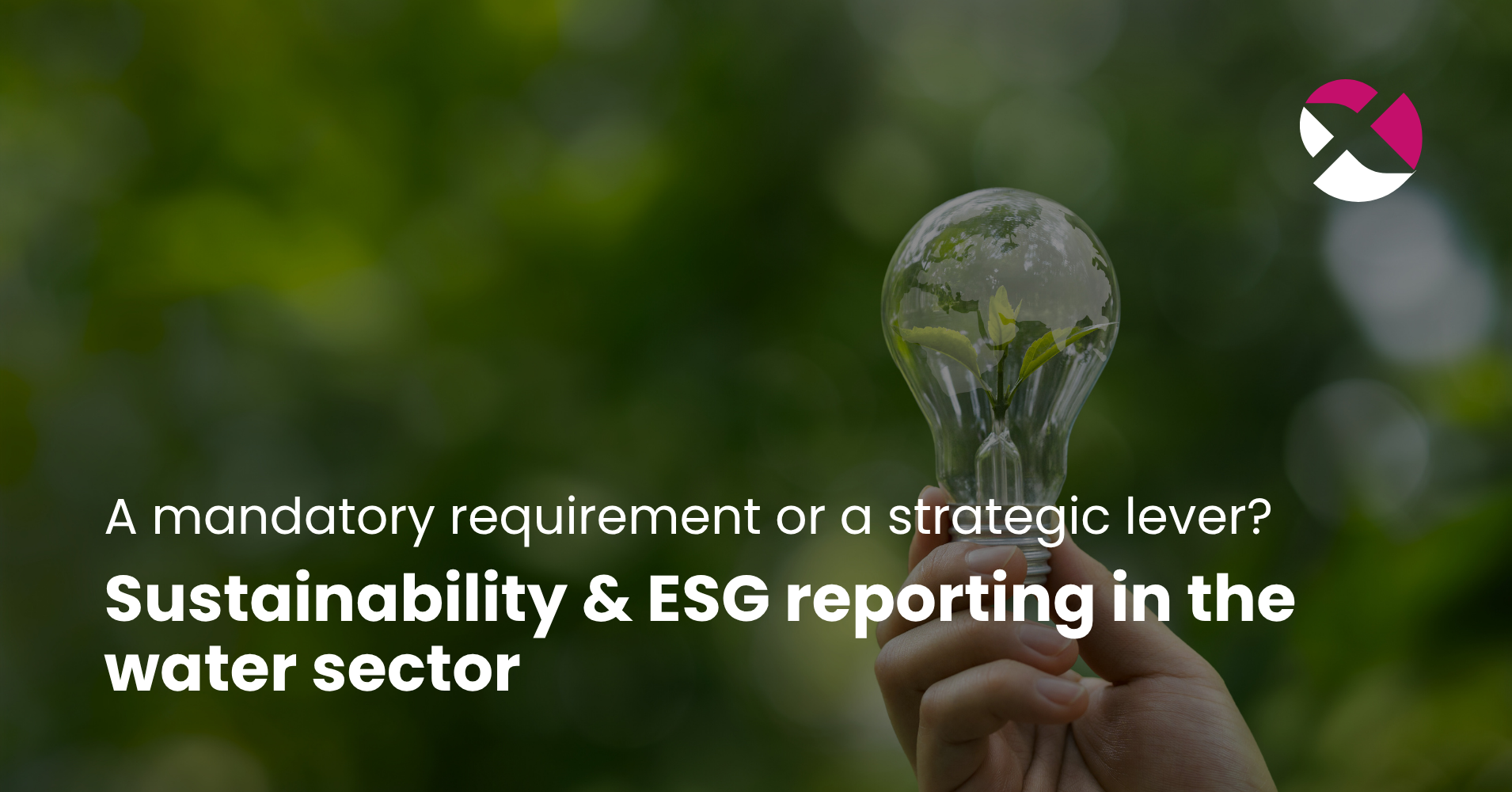
Sustainability & ESG Reporting in the Water Sector: Mandatory Requirement or Strategic Lever?
The standards in the water industry are currently shifting: In addition to supply security and technical quality, issues of sustainability and transparency are increasingly coming to the forefront. Climate change, resource scarcity, and new EU regulations such as the CSRD and ESRS are leading to ESG reporting becoming an increasingly integral part of corporate governance.
This raises a key question for many companies: How can sustainability be mapped in a way that not only fulfills reporting obligations but also contributes concretely to the management of decisions, investments, and operational processes?
ESG Reporting: From a “Nice-to-Have” to a Regulatory Reality
With the introduction of the Corporate Sustainability Reporting Directive (CSRD) and the associated European Sustainability Reporting Standards (ESRS), sustainability reporting has become mandatory—including for many players in the water sector. Organizations are required to report on their environmental, social, and governance performance in a detailed, comparable, and verifiable manner. The new requirements are already in effect and will be gradually extended to additional companies over the next reporting years.
This fundamentally changes the role of ESG:
What was previously used primarily as an image or communication tool is evolving into a central component of strategic and operational management.
For water utilities, this means in concrete terms:
- Environmental metrics such as energy consumption, CO₂ emissions, water losses, chemical use, and wastewater treatment plant performance must be systematically tracked.
- Social aspects such as supply security, accessibility in the event of a disruption, customer and employee satisfaction, and occupational safety are coming into sharper focus.
- Governance structures—from risk management and compliance to contracting and procurement processes—must be documented in a transparent and traceable manner.
The central challenge here is less the “whether” and more the “how.”
The reality on the ground: Between data chaos and resource bottlenecks
Many organizations in the water sector face similar starting points. ESG reporting collides with established structures, heterogeneous IT landscapes, and limited human resources.
Typical challenges include:
- Data is scattered across various departments and legacy systems (SCADA, GIS, ERP, spreadsheets, paper files).
- Key performance indicators are not standardized, are defined inconsistently, or are difficult to compare.
- Reporting is predominantly done manually—time-consuming, error-prone, and only once a year.
- ESG tasks are viewed as an “add-on” to day-to-day operations and are not understood as a separate management process.
At the same time, a strategic perspective is often lacking. ESG is viewed as an additional obligation—not as an opportunity to improve processes, efficiency, and resilience.
Yet sustainability is not a new topic in the water sector: water loss management, resource efficiency, energy optimization, and adaptation to climate change have always been part of the core business. What is new, above all, is the framework within which these achievements
- made visible,
- made measurable, and
- evaluated externally.
Making sustainability measurable: Data as the key
The key to effective ESG reporting is a robust data foundation. Without consistent, traceable, and regularly available data, any sustainability strategy remains fragmented.
The good news: The digitalization of the water industry offers a solution precisely here. Modern technologies make it possible for the first time to continuously and largely automatically capture relevant ESG metrics.
Technologies such as IoT, smart metering, and data-driven platforms enable:
- Real-time transparency regarding water consumption, pressure zones, energy usage, and losses.
- Early detection of leaks, anomalies, and inefficiencies in networks and facilities.
- Well-founded forecasts for resource requirements, peak loads, and infrastructure strain.
- Simulations and scenarios, for example regarding the impact of renovation measures or climate adaptation strategies.
These approaches are no longer a future scenario but are already standard practice in smart water management (Smart Data Worx).
This shifts ESG from a purely retrospective reporting requirement to an operational management tool:
Data used for ESG reporting can simultaneously be utilized in day-to-day operations to optimize processes, reduce losses, and better manage investments.
From Reporting to Management: ESG as a Strategic Lever
The true value of ESG only emerges when reporting, strategy, and operational management are consistently linked.
Specifically, this means:
- ESG metrics must not be left to “gather dust” in isolation within sustainability reports, but must be integrated into existing management tools (e.g., balanced scorecard, risk management, investment planning).
- Sustainability goals should be linked to operational KPIs—such as plant energy efficiency, leakage rates, response times to malfunctions, or resource reuse.
- Data analyses from ESG contexts can be used to continuously optimize networks, facilities, and processes.
In practice, this is demonstrated, for example, by:
- Integrating ESG into investment decisions:
Which renovation projects reduce not only losses but also CO₂ emissions? Which modernization efforts increase supply security while simultaneously lowering operating costs? - Linking sustainability goals to operational KPIs:
Reducing the leakage rate, lowering specific energy consumption per m³ of water, improving the recycling rate of sewage sludge, etc. - Using analytics for network development:
Data-driven prioritization of renovation measures, optimization of pump schedules, load and capacity management.
Especially in the context of water scarcity, extreme weather events, and rising energy prices, it becomes clear: efficiency, resilience, and sustainability go hand in hand.
Companies that strategically leverage ESG gain advantages:
- in meeting regulatory requirements,
- in operational performance, and
- in how they are perceived by municipalities, customers, and investors.
Best Practices: How to Get Started
The path to structured ESG reporting doesn’t have to be a massive undertaking. Successful organizations rely on a pragmatic, step-by-step approach.
Proven steps include:
- Clarify responsibilities
- Appointing an ESG officer or team
- Involving functional departments (Engineering, Finance, Human Resources, IT) in a cross-functional steering committee
- Conduct a materiality analysis
- Identifying the ESG issues that are truly relevant to the company and its stakeholders
- Focus on a few, but key, areas of action (e.g., water loss, energy efficiency, supply security, employee safety)
- Define measurable KPIs
- Select clear metrics for each area of action, including definition, data source, and responsibility
- Alignment with ESRS, industry-specific standards, and existing internal KPIs
- Launching pilot projects for data collection and integration
- Start in a defined area (e.g., a pressure zone, a wastewater treatment plant, a sub-network)
- Test automated data collection and analysis
- Derive lessons learned for the rollout
- Select suitable digital solutions
- Platforms that combine technical operational data and ESG requirements (e.g., Smart Data Worx)
- Focus on interoperability, scalability, and ease of use by business units
The key point is: perfection is not a prerequisite.
What matters more is to get started, learn continuously, and gradually professionalize processes.
Conclusion: ESG is here to stay
The water industry operates in the tension between rising demands and significant opportunities. ESG reporting has long been more than a regulatory requirement—it is a strategic lever for the industry’s future viability.
Those who implement ESG in a structured manner today will benefit tomorrow from:
- better, data-driven decision-making,
- more efficient and transparent processes,
- greater credibility with municipalities, customers, regulatory authorities, and investors,
- increased resilience to climate risks, resource scarcity, and regulatory changes.
The question is no longer whether ESG will be implemented—but how well and with what benefits for the core business.