Water is the elixir of life on earth, indispensable for humans, animals and plants. Global warming,...
Water Management in Transition: Why Planning Must Look Ahead
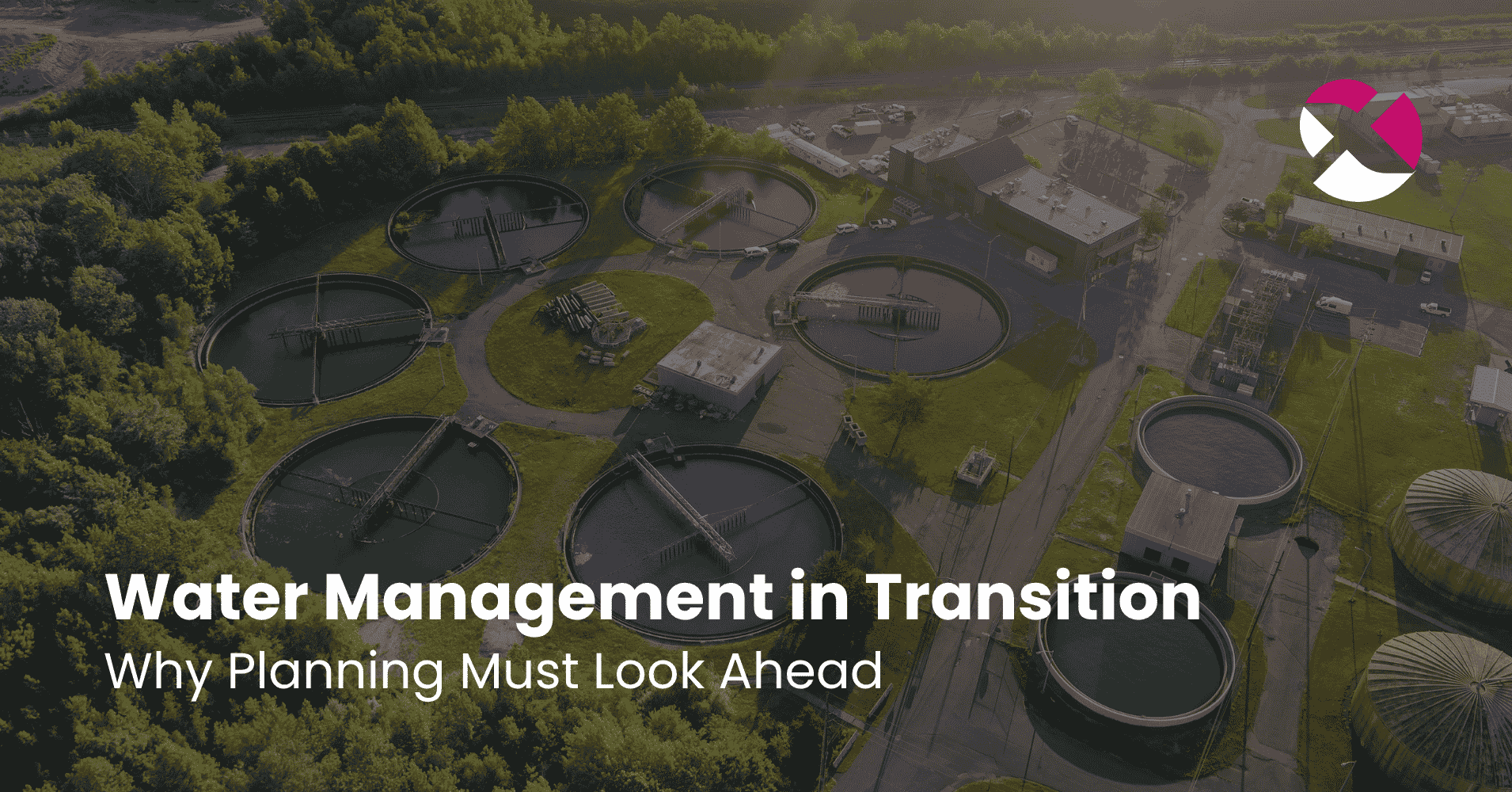
A heavy rainfall event can overwhelm sewer systems within minutes. During a hot summer, water demand can rise sharply. At the same time, groundwater levels are declining in some regions, while agriculture, industry, municipalities and private households all depend on the same resource. Situations like these make one thing clear: water management can no longer be planned around averages alone. It has to deal with extremes, regional differences and developments that are changing faster than much of the existing infrastructure can adapt.
For a long time, water in Germany was associated above all with reliability. In many regions, that reliability is increasingly coming under pressure. That is why it is no longer enough to act only once damage has already occurred. The key question today is no longer simply: What happened? It is: Where is a risk beginning to emerge — and what can we do before it turns into damage?
Experience remains important, but it is no longer enough on its own
Many decisions in water management are based on experience. That experience is valuable, because local expertise cannot simply be replaced by technology. Anyone who has managed a network for years knows its weak points, recurring issues and local particularities.
But water management is now being planned under very different conditions than just a few years ago.
A sewer network that was once sufficiently dimensioned may reach its limits as heavy rainfall events become more frequent. A water supply system designed around average consumption may suddenly have to cope with much higher peak demand during hot summers. Regions where water was long considered reliably available may come under pressure due to dry periods, reduced groundwater recharge or competing uses.
The German Environment Agency also points out that climate change, demographic shifts, changes in land use, technological developments and changing consumer behavior are creating new challenges for water management. Germany’s National Water Strategy is intended to make the way water is managed more resilient and future-proof over the long term.
For day-to-day practice, this means planning cannot only look backwards. It needs to combine local experience with current data, scenarios and forecasts.
Much of the data already exists — it is just rarely used together
Water management is not starting from scratch. Many municipalities, associations and utilities already have a wide range of information at their disposal: weather data, water levels, consumption figures, network data, condition assessments, heavy rainfall hazard maps, geospatial data, damage reports, land-use planning data and environmental information.
The challenge is often not a lack of data. The challenge is that the data is scattered.
One department works with maps. Another works with spreadsheets. Other information is stored in expert reports, specialist systems or individual projects. As a result, there is no shared picture of the situation. Decisions may be based on experience, but not always on all the information that is actually available.
This is where a shared data space becomes important. Not as another platform for its own sake, but as a practical basis for work: What data is already available? Who needs it? And how can it be connected in a way that creates a usable operational picture?
Only then does it become clear where risks overlap: ageing infrastructure, high levels of surface sealing, sensitive land uses, rising consumption, heavy rainfall hazards or falling groundwater levels.
Infrastructure decisions need to be made before problems become expensive
Water infrastructure is built to last. Pipes, sewers, storage facilities and treatment plants are not designed for a few years, but for decades. That is exactly why today’s decisions have long-term consequences.
If investments are only initiated once pipe bursts, flooding or supply shortages occur, the costs are usually higher. At that point, the focus is no longer on prevention, but on damage control.
Data can change this perspective. It can help identify which assets are under particular strain, which sections of the network are showing warning signs, where peak demand is emerging or which areas are especially vulnerable to heavy rainfall.
This makes decisions more specific:
-
Which measure should be implemented first?
-
Where would rehabilitation have the greatest impact?
-
Where is additional water retention needed?
-
Where can existing infrastructure be used more efficiently through better control?
-
Which investment reduces not just one isolated problem, but risk across the entire system?
Precisely because infrastructure has such a long service life, planning decisions need to be made earlier and on a more informed basis.
A practical example: When the sewer is not the only problem
After several heavy rainfall events, a municipality notices that certain streets are repeatedly affected. The obvious response might be: the sewer needs to be enlarged.
That may be true. But it may also be too narrow a view.
A damage report only shows where water appeared. Only when it is combined with heavy rainfall maps, terrain models, surface sealing data, sewer condition data and flow paths does it become clear why this particular street is affected.
Perhaps the problem is not just the sewer. Perhaps water from heavily sealed surfaces is being channelled into the same area. Perhaps there is a lack of retention space. Perhaps the topography is making the situation worse. Perhaps a combination of unsealing surfaces, infiltration areas, green retention measures and targeted sewer upgrades would be more effective than a single construction measure.
This is where data-based planning creates real value. It does not only show where a problem occurs. It helps explain why it occurs and which combination of measures is likely to have the greatest impact.
Digital twins make decisions easier to understand
The more factors interact, the harder it becomes to base decisions on isolated measurements, maps or spreadsheets. Digital twins can help bridge that gap.
They create a digital representation of water management systems and make it possible to compare different scenarios. What happens during a heavy rainfall event? How does the supply situation change during longer heat periods? What impact would a new retention area have? Where do bottlenecks occur if consumption rises in certain neighborhoods?
These questions are easier to answer when data is not viewed in isolation. Sensors provide up-to-date information on water levels, flow rates, pressure, fill levels, water quality or soil moisture. Forecasting models can estimate future developments. Digital twins make this information understandable in both spatial and technical terms.
The decisive factor is not the technology itself, but whether it leads to better decisions.
Resilience is created through interaction
A resilient water sector is not created through one single measure. It emerges from the interaction of many approaches: stormwater management, surface unsealing, infiltration, storage solutions, water reuse, intelligent network control and cooperation across municipal boundaries.
Water-conscious urban and regional development is particularly important. Rainwater should not simply be drained away as quickly as possible. It can be stored, allowed to infiltrate or made available for green spaces. This reduces pressure on sewer systems, helps mitigate heat and strengthens the local water balance.
For these measures to work together, everyone involved needs to work from the same foundation. Water affects many interests: public supply, agriculture, industry, urban development, environmental protection and flood risk management. Without reliable information, many of these interdependencies remain invisible.
A shared data space creates transparency. It helps stakeholders view interests, risks and measures not separately, but as part of a connected system.
Getting started does not have to mean launching a major project
For many municipalities and utilities, data-based planning may initially sound like a large-scale transformation project. It does not have to be.
Often, the first step is simply to bring together existing data sources: damage reports, network data, heavy rainfall maps, consumption data, groundwater information, planned construction and rehabilitation measures or land-use data.
Even this can create a clearer picture: Where do risks overlap? Which measures are already planned? Which decisions depend on one another? And where is it worth taking a closer look?
Three questions can help when getting started:
-
Which water-related data already exists but is still being used separately?
-
Where do risks overlap, for example heavy rainfall, surface sealing, ageing infrastructure or rising consumption?
-
Which measures can be compared before investments are made?
This makes data-based planning tangible. Not as an abstract objective, but as a practical route to better decisions.
Digitalization requires trust
The more digitally water management operates, the more important security and reliability become. Water data is sensitive. Systems need to be protected, models need to be understandable and responsibilities need to be clearly defined.
For data to be truly used, stakeholders need to be able to trust it. This requires good data quality, secure data spaces, clear roles and robust emergency concepts.
The best decisions are made when local experience and current data come together. Experience shows which local particularities matter. Data helps make developments visible earlier and provides a clearer basis for explaining and justifying decisions.
Protecting water means knowing earlier where action is needed
Water management is being planned under very different conditions today than just a few years ago. Extreme weather, competing uses, ageing infrastructure and rising requirements are making decisions more complex.
The sector cannot continue to respond only after problems have occurred. It needs a better shared picture of the situation in order to identify risks earlier, compare measures and plan investments more effectively.
More data alone does not solve the problem. Its value only emerges when existing information is connected in a way that leads to better decisions.
For municipalities, utilities and water associations, forward-looking, data-based planning is becoming an important building block for supply security. Because anyone who wants to protect water sustainably and use it fairly needs to recognize earlier where risks are emerging — and which measures will actually work.